Keeping on top of property repairs
Maintenance is one of the parts of being a landlord that is easy to lose track of. A boiler callout here, a leaking roof there, a contractor who takes three weeks to turn up. Without a log, you end up trying to piece together the year from emails, text messages, and a drawer of receipts in January.
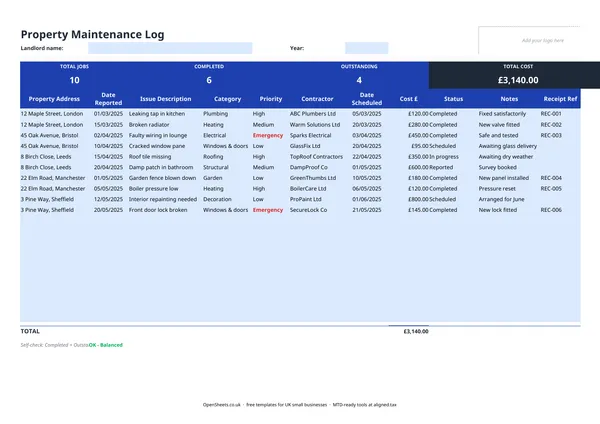
This template gives you one row per job. You can see every outstanding issue across all your properties, who is dealing with it, how much it cost, and whether you have the receipt to back up the claim.
What the records are actually for
Keeping a maintenance log is not just good admin. It does three practical things.
It backs up your expense claims. Repairs and maintenance are an allowable expense against your rental income, which means you need to be able to show HMRC what the money was spent on if they ask. A log with the date, contractor name, job description, cost, and receipt reference gives you everything in one place.
It shows a property’s repair history. When something keeps breaking, or when you are deciding whether to replace rather than repair, a complete history of what has been done helps you make the call. It is also useful when you sell, because buyers and their surveyors will ask.
It helps you chase contractors. The Status and Date Completed columns make it easy to see what is overdue. If a contractor quoted in October and it is now December, you will know.
Repairs versus improvements
This is the one distinction that catches landlords out most often. It matters because it affects how you claim the cost.
A repair or like-for-like replacement is an allowable revenue expense. You deduct it from your rental income in the tax year you paid for it, which reduces your tax bill.
An improvement (work that makes the property better than it was before the issue arose, not just back to how it was) is a capital expense. You cannot deduct it from your rental income. It may reduce a Capital Gains Tax bill when you eventually sell the property.
The line between the two can be genuinely unclear. Replacing single-glazed windows with double-glazed ones is probably an improvement. Replacing broken double-glazed units with the same spec is probably a repair. If a job is large or the distinction is not obvious, keep the invoices and get your accountant’s view before claiming.
Common mistakes landlords make with maintenance records
Keeping receipts but not recording what the job was. A receipt that says “labour: £350” tells you very little six months later. Add the issue description and address in the log at the time, while it is fresh.
Claiming improvements as repairs. An honest mistake can become a problem in an HMRC enquiry. Use the Notes column to record the scope of the work, especially for larger jobs.
Losing track of who you paid. If you use several contractors across several properties, it is easy to forget who did what. The Contractor column solves this, and it becomes useful if you need to call them back for a warranty job.
Not recording outstanding issues. The log is just as useful for jobs that have not been done yet. An Outstanding row for a repair you know is needed helps you budget and prioritise.
Allowable property expenses (a quick reminder)
For UK landlords, the common allowable expenses against rental income include repairs and maintenance, letting agent fees, landlord insurance, ground rent and service charges, and professional fees such as accountancy. Finance costs (mortgage interest) now operate as a 20% tax credit rather than a direct deduction for most landlords, which is a different calculation again.
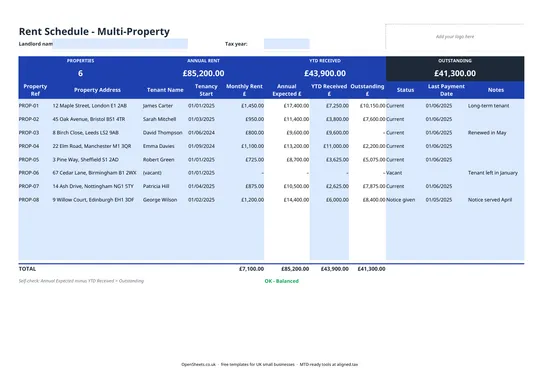
This template covers the repairs and maintenance piece. For a full picture of your property income and expenses across the year, the rent schedule and the property income tracker in the OpenSheets library cover the rest.
Making Tax Digital for property landlords
If your combined income from self-employment and property is over £50,000, Making Tax Digital for Income Tax applies to you from April 2026. The threshold drops to £30,000 in April 2027 and to £20,000 in April 2028.
Under MTD, you keep digital records of your property income and expenses and send HMRC a quarterly update instead of a single annual return. The records you need are exactly what this log already tracks: the date, a description of the work, the cost, and enough detail to categorise it correctly.
HMRC’s expense category for this kind of cost is repairs and maintenance (sometimes listed under “rent, rates and insurance; repairs and maintenance” in their property income categories). The Cost £ totals from this log feed directly into that category on your quarterly update. No rekeying.
When you are ready to file, Aligned (aligned.tax) connects your spreadsheet to HMRC’s MTD system. You keep your records exactly as you do now. Aligned reads the totals and sends the quarterly update on your behalf. It is free bridging software, so there is no need to switch to a separate accounting package or re-enter your data.
Landlords with well-kept records are in a much better position than they realise. The maintenance log is the work. Aligned is what turns it into a quarterly filing.