What a 13-week cash flow forecast is and who uses it
A 13-week cash flow forecast shows you, week by week, the cash you expect to receive and the cash you expect to pay out over the next quarter. The result is a running closing balance for each week, so you can see at a glance when cash is comfortable and when it gets tight.
Thirteen weeks is the standard short-term horizon for a reason. It covers a full calendar quarter, it aligns with VAT return periods if you are VAT-registered, and it is close enough to the present that your estimates can be grounded in real numbers. Go further out and you are mostly guessing. Stay closer in and there is not enough runway to act on what you find.
Sole traders use it to stay on top of their cash position. Small limited companies use it to manage working capital. Landlords use it to track rental income against mortgage payments and maintenance costs. It is also one of the first things a bank will ask for if you are looking for a loan or overdraft.
How the template works
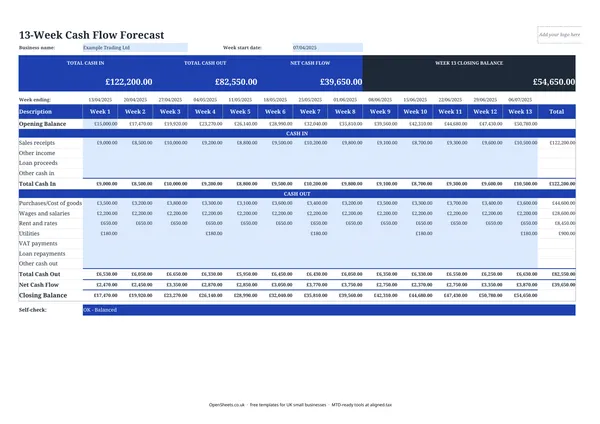
The spreadsheet has a row for each type of cash movement. Cash In covers Sales Receipts and Other Cash In. Cash Out covers Purchases (cost of goods), Wages and Salaries, Rent and Rates, Loan Repayments, and Other Cash Out.
Each column is one week. The Opening Balance for Week 1 is the only figure you enter manually at the start. After that, the closing balance from each week flows automatically into the next week’s opening balance. The Net Cash Flow row shows whether more cash arrived or left that week. A negative figure means more went out than came in.
The summary panel on the right totals the full 13 weeks: Total Cash In, Total Cash Out, Net Cash Flow, and the Week 13 Closing Balance.
UK tax and record-keeping
Why timing matters for UK sole traders
UK income tax is due on profits, not on cash received. But cash flow problems do not wait for your tax bill. The gap between when you earn income and when cash actually arrives, because a client pays late or because a large VAT bill lands in one go, is where most small business cash crises start.
The records you are required to keep for HMRC are income and expenditure records, not cash flow records. But a cash flow forecast built on the same figures as your bookkeeping is a useful cross-check. If your forecast says you should have £15,000 in the bank and you actually have £9,000, something has not been recorded correctly.
VAT and the quarterly cash lump
If you are VAT-registered and on standard quarterly VAT returns, a large payment falls every three months. Many sole traders get caught out by not putting money aside for VAT as they go. Use the Other Cash Out row to include your estimated VAT payment in the week you expect to make it. That way the impact shows up in your forecast before it arrives.
Common mistakes to avoid
Starting with the wrong opening balance. The opening balance must be your actual bank balance on day one of the forecast, not an estimate or an old figure. Get this wrong and every week that follows will be out by the same amount.
Leaving out irregular payments. Annual insurance premiums, accountancy fees, equipment servicing, and tax payments are easy to miss because they do not happen every month. Check your calendar for the next 13 weeks and put anything that falls in that window into the forecast.
Confusing invoiced amounts with cash received. If you invoice a customer in Week 2 but they pay in Week 5, the cash belongs in Week 5, not Week 2. The forecast tracks when money moves, not when it is earned.
Not updating it. A 13-week forecast you filled in three months ago and never touched is a historical document, not a forecast. The value is in updating it each week with actual figures and refreshing your forward estimates as things change.
Keeping clean records and Making Tax Digital
If your combined income from self-employment and property is over £50,000, Making Tax Digital for Income Tax applies to you from April 2026. The threshold drops to £30,000 from April 2027 and to £20,000 from April 2028.
Under MTD, you keep digital records of your business income and expenses and send HMRC a quarterly update, rather than only filing once a year. A cash flow forecast is not a substitute for the bookkeeping records MTD requires, but the two work naturally side by side. The weekly figures you track here feed straight into a bookkeeping record, and it is that record that goes to HMRC each quarter.
When you are ready to send your quarterly updates, Aligned (aligned.tax) is worth a look. It is free MTD bridging software that connects your existing spreadsheet records to HMRC. You keep working exactly as you do now, and Aligned sends the update on your behalf.