What an employee record is and who uses it
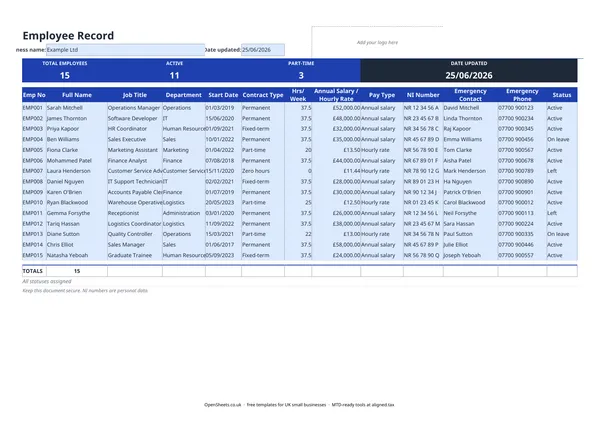
An employee record is where you keep the basics about each person who works for you: job title, department, start date, contract type, contracted hours, pay details, National Insurance number, and an emergency contact.
Small businesses and sole traders who take on their first members of staff often track this kind of information across email chains, paper files, and memory. That works for a while, and then it does not. A spreadsheet with one row per employee is a simple step up that pays off quickly, especially if HMRC or an employment tribunal ever asks you to produce records at short notice.
This template suits employers with a small team, up to around twenty or thirty people, where dedicated HR software feels like overkill but no system at all creates real risk.
What UK employment law says you must keep
UK employers are legally required to keep certain records. Here are the main ones this template helps with.
Payroll records. You must keep records of gross pay, deductions, and employer National Insurance contributions for at least three years from the end of the tax year they relate to. PAYE real-time information (RTI) submissions to HMRC depend on having these details accurate before every payroll run.
Employment contracts. The written statement of employment particulars must be given to most employees on or before their first day. Keep a copy. If a dispute arises later, you will need it.
Right to work checks. You must check and keep evidence that each employee has the right to work in the UK before they start. The check must be repeated for employees on time-limited visas. Keep copies of the documents you checked, along with the date you carried out the check.
Working time records. If your employees are subject to the Working Time Regulations, you are required to keep records showing that the average 48-hour week limit is not breached (unless the employee has opted out in writing). Keep signed opt-out agreements where you have them.
None of this is complicated, but all of it depends on having somewhere to record it. This template covers the personal and payroll fields. For contracts, right to work documents, and disciplinary records you will need separate files or folders alongside it.
National Insurance numbers and payroll accuracy
Every UK employee has a unique National Insurance number, in the format two letters, six digits, one letter (for example AB123456C). You need it to run payroll correctly and to make RTI submissions to HMRC. Do not skip this field.
If a new starter does not have their NI number to hand on day one, they can find it on a payslip, P60, or through their personal tax account on gov.uk. Do not begin payroll without it if you can avoid it. An incorrect or missing NI number can cause problems with HMRC that take time to unpick.
Handling data securely
Employee records contain personal data. NI numbers, pay details, and emergency contact information can cause real problems if they end up in the wrong hands. A few practical steps go a long way:
Password-protect the spreadsheet file. Excel allows you to set a password under File > Info > Protect Workbook. Use a strong password and store it somewhere secure, separate from the file itself.
Restrict access. Only the people who need the records to do their job should be able to open the file. If it lives on a shared drive, check the folder permissions.
Keep a backup. A locked-down copy on an encrypted drive or a secure cloud folder means you still have the records if a device is lost or fails.
Tell employees what you hold. Under UK GDPR, employees have the right to know what personal data you keep about them and why. A short, plain-English privacy notice covers this. The ICO website has templates for small employers.
Common mistakes small employers make
Deleting leavers instead of marking them inactive. Once a row is gone, it is gone. Change the Status column to Inactive when someone leaves, and keep the record for at least six years. Reference requests, redundancy calculations, and HMRC enquiries can all relate to people who left years ago.
Not recording the contract type clearly. Whether someone is employed or self-employed, permanent or fixed-term, full-time or part-time matters for pay, tax, holiday entitlement, and notice periods. Be precise from the start.
Mixing up employment status and tax status. Someone can be a director and an employee at the same time. A contractor paid through an agency may still be your worker for some purposes. If you are unsure about the status of someone you engage, take advice before you run your first payroll. The distinction changes what you owe in PAYE.
Letting emergency contact details go stale. People change their next of kin and phone numbers. Add a reminder to check these details annually, for example during a pay review or at the start of a new tax year.
Record-keeping and running a small business
Good records are what separate a straightforward HMRC enquiry from a difficult one. Employee records are one part of that picture. If you also keep your business income and expenses in a spreadsheet, the same habits apply: consistent, up-to-date, backed up, and held securely.
If your combined income from self-employment and property is heading toward the Making Tax Digital thresholds (over £50,000 from April 2026, £30,000 from April 2027, or £20,000 from April 2028), it is worth knowing that Aligned (aligned.tax) lets you send your quarterly income and expense records to HMRC straight from the spreadsheet you already use. Worth bookmarking for when the time comes.