What this template does
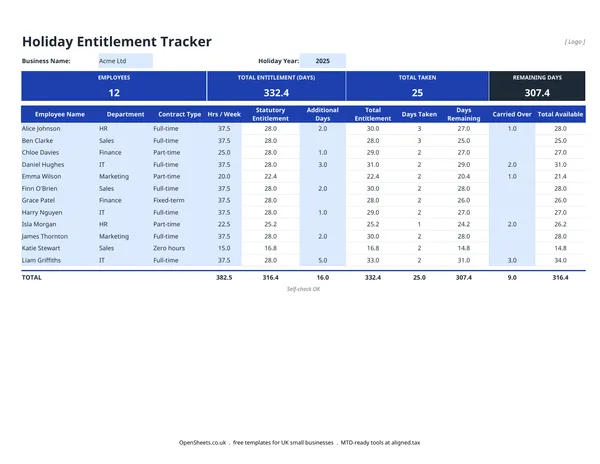
This spreadsheet gives small businesses and sole traders with staff one place to track paid leave across the whole workforce. You can see how much holiday each employee is entitled to, how many days they have taken, and how many remain, whether they are full-time, part-time, fixed-term, or on a zero-hours contract.
The summary panel at the top of the sheet adds everything up: total employees, total entitlement in days, days taken, and days still available. You are never left guessing whether someone is about to run out of leave or carrying an awkward surplus into the new year.
UK statutory holiday entitlement: the basics
UK workers are entitled to paid annual leave under the Working Time Regulations 1998. The statutory minimum is 5.6 weeks per year. For someone working five days a week, that comes to 28 days. Many employers include the eight bank holidays in England and Wales within that figure; others give 28 days on top of bank holidays. What matters is that employees receive at least the statutory minimum in total.
For part-time workers, entitlement is pro-rated to reflect their contracted days or hours. For workers on irregular hours or zero-hours contracts, the calculation is based on time worked. The rules for this group were updated relatively recently. If you have workers on variable schedules, check the current gov.uk guidance or take advice to make sure you are calculating correctly.
You can always give more than the statutory minimum. Many employers add extra days for long service or as part of a benefits package. The Additional Days column in this template handles that.
Statutory minimum versus contractual entitlement
The difference between what the law requires and what you have promised in writing matters more than most employers realise.
The statutory minimum is the floor. Your employment contract may sit above it. If your contracts say 25 days plus bank holidays, that is what your employees are entitled to, regardless of what the statutory floor is. This template tracks both: the statutory entitlement calculates automatically, and any additional contractual days sit alongside it so the Total Entitlement figure reflects what you have actually committed to.
If your contract is less generous than the statutory minimum, the law overrides the contract. You cannot offer less than 5.6 weeks, even if the employee has signed a contract that says otherwise.
Contract types and what they mean for leave
The template covers four contract types. Here is what to keep in mind for each.
Full-time. Five days a week, standard entitlement of 28 days (or 5.6 weeks). Straightforward to track.
Part-time. Entitlement is calculated proportionally. A worker doing three days a week gets 3/5 of 28 days, which is 16.8 days. The template handles the maths once you enter the contracted hours.
Fixed-term. Workers on fixed-term contracts have the same rights as permanent employees. They accrue leave during their contract and must be able to take it or be paid in lieu at the end.
Zero hours. Entitlement here is based on hours actually worked rather than contracted hours. The calculation has changed in recent years and can catch employers out. Use the hours-based figure as a starting point, but verify it against current gov.uk guidance, especially if a worker’s hours vary significantly week to week.
Common mistakes to avoid
Treating bank holidays as automatic extras. Whether bank holidays sit inside or outside the 28-day minimum depends on what your contracts say. If they are included, you cannot require employees to take them as part of their leave without their consent. Read your contracts carefully and make sure the template reflects what is actually agreed.
Letting leave accumulate with no plan. If employees are carrying large surpluses towards the end of the year, it is a sign leave is not being managed actively. A large end-of-year payout, or everyone taking leave at once to clear it, causes problems. Checking the Days Remaining column monthly keeps this under control.
Getting part-time and zero-hours calculations wrong. The rules for irregular-hours workers were updated and the old 12.07% accrual method no longer applies in all cases. If you are unsure, check gov.uk or take employment advice. Using the wrong figure exposes you to an unlawful deduction claim.
Not updating the tracker when someone leaves. A leaver is entitled to be paid for any untaken statutory leave accrued up to their leaving date. Mark their row clearly and use the Days Remaining figure to calculate what is owed. Keep the record in case it is queried later.
Keeping the records tidy
Good leave records are worth the ten minutes a month they take to update. If HMRC ever queries your payroll, holiday pay is part of the wage bill, and gaps in leave records can make a payroll audit harder than it needs to be.
If you keep your accounts in a spreadsheet, Aligned (aligned.tax) is worth knowing about. It is free Making Tax Digital software that connects your existing records to HMRC, for sole traders and landlords who want to file without switching to full accounting software.