What a trial balance is
A trial balance is a list of every account in your bookkeeping system at the end of an accounting period, usually your financial year. Each account appears once, with its balance shown as either a debit or a credit. If your records are correct, the two columns add up to the same figure.
It is not a formal financial statement in the way a profit and loss account or a balance sheet is. It is a working document, an internal check that sits between your day-to-day records and the final accounts. Most accountants ask for one as the first step when preparing year-end accounts. Having it ready can save time and, in some cases, reduce your bill.
How debits and credits work on a trial balance
If you have not worked with double-entry bookkeeping before, the logic is straightforward once you see the pattern.
Every transaction in your books has two sides: a debit entry and a credit entry of the same amount. Over time, the sum of all debit balances and the sum of all credit balances should always be equal.
The type of account determines which column its closing balance goes in:
- Assets (bank, trade debtors, fixed assets, petty cash) normally carry a debit balance.
- Liabilities (trade creditors, bank loan, VAT liability) normally carry a credit balance.
- Equity and capital (capital account, retained earnings) normally sit in credit.
- Income and sales are credit balances.
- Expenses (wages, rent, cost of goods sold, depreciation) are debit balances.
If an account has a balance on the opposite side to what you would expect, it is worth looking into. A credit balance on a trade debtor account, for example, might mean a customer has overpaid. Or it might be a posting error.
What the columns in this template mean
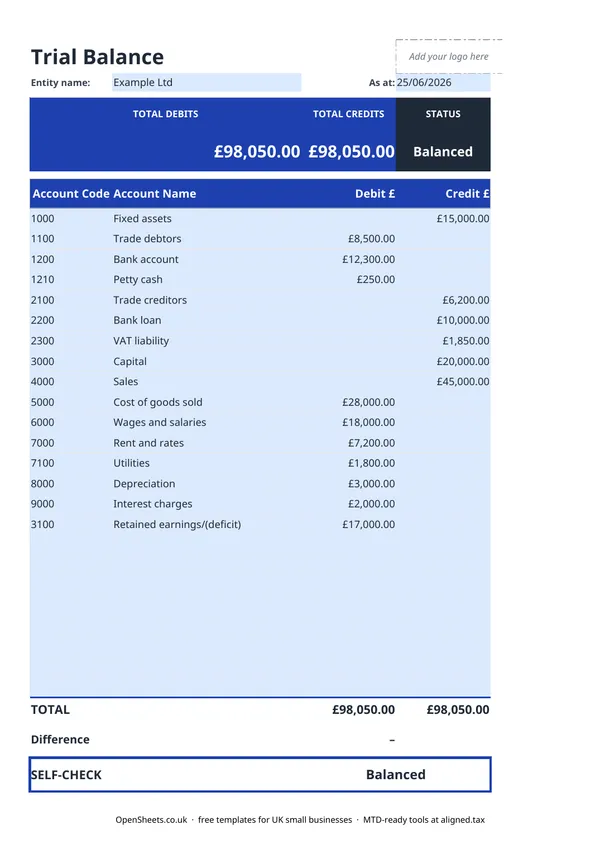
The template has four columns and a summary panel at the top.
Account Code. A short reference number for each account (for example, 1000 for fixed assets, 4000 for sales). You can use any scheme you like, or leave this blank if you do not use account codes.
Account Name. The plain-English name for the account. The sample rows use common UK bookkeeping categories, but rename or add rows to match your own chart of accounts.
Debit £. The closing balance for accounts that normally sit in debit (assets, expenses).
Credit £. The closing balance for accounts that normally sit in credit (liabilities, equity, income).
The summary panel at the top shows live totals for Total Debits and Total Credits, with a Status cell that reads Balanced when they match. The SELF-CHECK row at the bottom confirms the same thing in a single glance.
Common mistakes to avoid
Entering a balance in both columns for the same account. Each account gets one figure in one column only. Putting a number in both debit and credit on the same row will throw off your totals.
Confusing balance sheet and profit and loss accounts. Both appear on a trial balance. Fixed assets and bank balances sit alongside sales and wages. That is normal. Your accountant separates them when preparing the final accounts.
Not reconciling to your bank statement. Your bank account balance on the trial balance should match your bank statement, after allowing for any outstanding payments or receipts. If it does not, find the difference before you hand anything over.
Only running it at year end. There is no rule that says once a year is enough. Running a trial balance at the end of each month or quarter means errors come to light while the records are still fresh. It also makes your year-end process much calmer.
Keeping clean records for tax and MTD
If your books are organised enough to produce a trial balance, you are already doing the hard part of good tax record-keeping. The figures in it feed directly into the accounts your accountant prepares and, if you file Self Assessment, into the income and expense totals you report to HMRC.
If your combined income from self-employment and property is over £50,000, Making Tax Digital for Income Tax already applies to you from April 2026. The threshold drops to £30,000 in April 2027 and £20,000 in April 2028. Under MTD you send HMRC a quarterly summary of your income and expenses digitally, rather than filing once a year.
Good spreadsheet records kept through the year are most of what MTD needs. Aligned (aligned.tax) is free MTD bridging software that reads your spreadsheet and sends the quarterly update to HMRC on your behalf, with no need to switch to separate accounting software. Worth bookmarking now if the threshold is approaching.